calvincollins · xyz

Predictions, by category

The Forecast Desk

“Every number earned, every call on the ledger.”

56 markets 189 priced outcomes 12 categories 6 graded · record 2–4 book leader Nico Tilt $1,292
📒 The Track Record — the roster’s bankrolls, every graded call scored →
The PredictorsCompare all →

Sport & Games

Live calls on games with a scoreboard — graded the moment the whistle goes8 markets

Tennis 4

Live marketSport & Gameslogged Friday, July 31, 2026

Who will win the 2026 US Open Women's Singles title?

🇧🇾
Sabalenka
28–33%

Aryna Sabalenka is favored at 28–33% to become the first three-peat US Open champion since Serena Williams, riding a 23-1 hard-court season; Iga Swiatek is the runner-up at 15–19%, with Elena Rybakina — the one player who beat Sabalenka in a 2026 major final — the live dissent pick. The seven standing profiles split 4–1–2.

👥 7 predictor profilesgrades Saturday, September 12, 2026📋 on the ledger
Livegrades Sunday, September 13, 2026

Who will win the 2026 US Open Men's Singles title?

Jannik Sinner is favored at 48–55% off a 44-3 season and a fifth major at Wimbledon, but Carlos Alcaraz — last year's champion here, reportedly fully healed from his wrist injury and returning at Cincinnati in August — is the live runner-up at 18–24%; the seven standing profiles split 4–2–1.

🇮🇹Sinner48–55%
7 predictor profiles · on the ledgerFull forecast →
✗ GradedSaturday, July 11, 2026

Who will win the 2026 Wimbledon Ladies' Singles title?

Aryna Sabalenka is the single most likely name at 25–30%, held right at her exact-question price — but a champion is collectively likelier to come from the field, the honest runner-up at 22–30%; the seven standing profiles split 5–1–1.

🇨🇿 Linda Nosková won🇧🇾 called Sabalenka 25–30%
✗ the desk missed · Brier 0.076The grade →
✓ GradedSunday, July 12, 2026

Who will win the 2026 Wimbledon Gentlemen's Singles title?

Jannik Sinner defends at 53–59% — a live No. 1 and defending champion at the most seed-friendly major, with Alcaraz withdrawn; a bottom-half challenger is the runner-up at 16–22% and Elias Lantern backs a fated Djokovic 25th. The seven standing profiles split 3–2–2.

🇮🇹 Sinner won🇮🇹 called Sinner 53–59%
✓ the desk called it · Brier 0.194The grade →

Baseball 1

Live marketSport & Gameslogged Friday, July 31, 2026

Will the Houston Astros make the 2026 MLB playoffs?

🚫
Astros miss the playoffs (NO)
66–72%

Houston sits 55-55, half a game out of the last AL Wild Card spot in one of the tightest five-team bubbles in baseball, but sportsbooks price them at only 28–34% to make it (66–72% NO) — the standings look like a coin flip, the market says the underlying roster isn't. The seven standing profiles split 5–2 toward NO.

👥 7 predictor profilesgrades Sunday, October 4, 2026📋 on the ledger

Basketball 1

✗ Graded — the desk missedSport & Gameslogged Friday, July 3, 2026

Which NBA team will LeBron James play for during the 2026-27 regular season?

🔔
Philadelphia 76ers
won
🍷
Cleveland Cavaliers
called 36–44%

LeBron signed a two-year, $8M deal with Philadelphia — his 'last decision' — joining Joel Embiid and newly-acquired Jaylen Brown, after weeks of speculation centered on Cleveland, Miami, and Golden State.

👥 7 predictor profiles🏁 graded Friday, July 24, 2026📉 Brier 0.160

Football 2

✗ Graded — the desk missedSport & Gameslogged Friday, July 3, 2026

Will Brazil advance past Norway in the 2026 World Cup Round of 16?

🇳🇴
Norway advances
won
🇧🇷
Brazil
called 62–68%

Erling Haaland scored twice in the final eleven minutes (79', 90') to send Norway through 2-1; Neymar's penalty in stoppage time came too late. Norway reached the World Cup quarterfinals for the first time.

👥 7 predictor profiles🏁 graded Sunday, July 5, 2026📉 Brier 0.423
✗ GradedSunday, July 19, 2026

Who will win the 2026 FIFA World Cup?

Six standing predictor profiles each committed to one champion; the council's consensus pick is France at 28–32%, with Ada Ledger's Argentina dissent preserved.

🇪🇸 Spain won🇫🇷 called France 28–32%
✗ the desk missed · Brier 0.090The grade →

Politics & the Economy

Elections, Washington, and the wars — bare-topic calls, not drawn from a corpus14 markets

The 2026 Midterms 10

Live marketThe Modern Worldlogged Saturday, August 1, 2026

Who wins the 2026 Texas U.S. Senate race?

🔴
Ken Paxton
52-60%

Ken Paxton is favored near 52-60% on Texas’s three-decade Democratic statewide drought, but two deep markets disagree with each other and James Talarico’s historic fundraising edge keeps a genuine upset path alive.

👥 7 predictor profilesgrades Tuesday, November 3, 2026📋 on the ledger
Livegrades Tuesday, November 3, 2026

Who wins the 2026 New Hampshire U.S. Senate race?

Chris Pappas is favored for the open seat near 70-78%, backed by a 2:1 cash edge and a collapsing Trump approval — but a tightening polling trend keeps John Sununu’s comeback bid live.

🔵Chris Pappas70-78%
7 predictor profiles · on the ledgerFull forecast →
Livegrades Tuesday, November 3, 2026

Who wins the 2026 Michigan U.S. Senate race?

Democratic primary favorite Abdul El-Sayed is favored in the general near 52-60%, but his own matchup polling against Mike Rogers runs measurably weaker than rival Haley Stevens’s — a real Republican path stays open in this open-seat race.

🔵Abdul El-Sayed52-60%
7 predictor profiles · on the ledgerFull forecast →
Livegrades Tuesday, November 3, 2026

Who wins the 2026 Georgia governor's race?

Keisha Lance Bottoms is favored near 53-61% for the open seat after Republican Rick Jackson declined a debate, but his still-unspent $87M ad blitz and a near-tied June poll keep the race live.

🔵Keisha Lance Bottoms53-61%
7 predictor profiles · on the ledgerFull forecast →
Livegrades Tuesday, November 3, 2026

What will the national House popular-vote margin be in 2026?

A Democratic-leaning national House result of four to ten points is the modal call, anchored on a real prediction market and the current polling average — with a genuine wave scenario and a compression toward toss-up both kept live.

🔵Democratic-leaning result (D+4 to D+10)46-55%
7 predictor profiles · on the ledgerFull forecast →
Livegrades Tuesday, November 3, 2026

Which party will control the U.S. Senate after the 2026 midterms?

Republicans are favored to keep the Senate — about 58% once the hold sub-paths are summed — because the 2026 map makes Democrats net four seats while defending Georgia and Michigan. The modal path is a narrow GOP hold as the map absorbs a strong Democratic wind.

🔴Narrow GOP hold46-54%
7 predictor profiles · on the ledgerFull forecast →
Livegrades Tuesday, November 3, 2026

Who wins the 2026 North Carolina U.S. Senate race — Cooper or Whatley?

The open Tillis seat is Democrats' clearest pickup: former governor Roy Cooper leads RNC chair Michael Whatley and is priced near 78% once the thin market is discounted for a summer lead four months out.

🔵Roy Cooper74-82%
7 predictor profiles · on the ledgerFull forecast →
Livegrades Tuesday, November 3, 2026

Who wins the 2026 Maine U.S. Senate race — Collins or Platner?

The one true toss-up of the five. The markets tilt to Democrat Graham Platner (~57%) on Maine's blue lean, but head-to-head polls are a dead heat and Susan Collins has outrun her state before.

🔵Graham Platner52-58%
7 predictor profiles · on the ledgerFull forecast →
Livegrades Tuesday, November 3, 2026

Which party will control the U.S. House after the 2026 midterms?

Democrats are ~83% to win the House on the deepest markets — the president's party has lost seats in 20 of the last 23 midterms — but a Republican-tilted map makes the modal path a narrow-to-moderate flip, not a wave.

🔵Narrow Dem flip48-58%
7 predictor profiles · on the ledgerFull forecast →
Livegrades Tuesday, November 3, 2026

Who wins the 2026 Georgia U.S. Senate race — Ossoff or Collins?

Democratic incumbent Jon Ossoff is favored near 78%, but Georgia's six straight sub-three-point top-of-ballot finishes mean the summer lead is built to compress. Mike Collins is the live underdog.

🔵Jon Ossoff70-78%
7 predictor profiles · on the ledgerFull forecast →

Washington & the Fed 2

Live marketThe Modern Worldlogged Friday, July 31, 2026

When the FY2027 appropriations/continuing-resolution fight comes to a head around September 30, 2026, does the federal government suffer a funding lapse (shutdown), or is one averted by a CR or deal?

🤝
CR or deal averts a lapse (NO SHUTDOWN)
42–52%

A near three-way split: a CR or deal narrowly leads at 42–52%, with an extended shutdown running neck-and-neck at 18–26% given this Congress already logged two funding lapses this fiscal year — the desk splits 3 averted / 3 extended / 1 brief.

👥 7 predictor profilesgrades Monday, October 5, 2026📋 on the ledger
Livegrades Thursday, September 17, 2026

What does the Federal Reserve do to its target interest rate at the September 16, 2026 FOMC meeting — hold, cut, or hike?

The live story flips the assumed question: a 25bp hike narrowly leads at 45–55%, not a cut, as oil above $100/bbl and hawkish new Chair Kevin Warsh push against a bare 35–45% hold — the desk splits 5 hike / 2 hold, a cut all but priced out at 3–8%.

🔥Hike — 25bp increase to 3.75%–4.00%45–55%
7 predictor profiles · on the ledgerFull forecast →

War & Geopolitics 1

Live marketThe Modern Worldlogged Friday, July 3, 2026

How does the Iran war resolve — settlement, another round, frozen standoff, regime change, or the bomb?

🕊️
Settlement Holds
31–41%

Five priced scenarios for the US–Israel–Iran confrontation: a funded settlement is the favorite at 31–41%, with a third war round overlapping at 27–37% — the six standing profiles split 3–2–1.

👥 7 predictor profilesgrades Sunday, December 31, 2028📋 on the ledger

The 2028 Race 1

Live marketThe Modern Worldlogged Friday, July 3, 2026

Who wins the 2028 US presidential election?

🔵
Democratic Party
52–58%

Democrats are the favorite to retake the White House at 52–58% — a weak favorite over a market-priced ~45% Republican hold, with the person race wide open (Vance the modal Republican, Newsom the modal Democrat); the six standing profiles split 4–2.

👥 6 predictor profilesgrades Tuesday, November 7, 2028📋 on the ledger

From the Research

Every research corpus's forecast, priced as a market16 markets

Thomas Carlyle 3

Openthrough ~2040

The Book That Burned

Thomas Carlyle's The French Revolution: A History (1837)

Stable niche survival55–65%
Scholarly recuperation / modest revival15–22%
Reputational erosion / cancellation drag15–22%
Popular rediscovery3–6%
4 outcomes · from the researchFull forecast →
Openthe work's evolving scholarly reputation

Carlyle's Everest

Carlyle's History of Friedrich the Great (1858–1865)

Continued scholarly revival on textual grounds60%
Persistent reputational shadow from the fascism association30%
Near-total neglect outside specialist circles10%
3 outcomes · from the researchFull forecast →
Openthrough 2035

The Calvinist Without a Creed

Thomas Carlyle and his Scottish Calvinist formation

Quiet Recovery (with political toxicity as headwind)40–50%
Politically Toxic / Scholarly Retreat15–25%
Substrate Synthesis10–20%
Surprise Mainstream Recovery10–20%
Residual tail3–7%
5 outcomes · from the researchFull forecast →

Faith & Religion 6

Openthrough ~2040 (trajectory of scholarly interpretation)

A Holy War and Its Poet

The Civil War's religious drivers — and Walt Whitman

Provincialization (most likely)45–55%
Transnational/Atlantic reframing dominates20–30%
Public-memory capture / culture-war repolarization15–25%
Stagnation / contraction5–15%
4 outcomes · from the researchFull forecast →
Openthrough 2050

The Man and the Christ

The message and divinity of Jesus
Mystical-Individualist Revival30–40%
Post-Liberal Orthodox Resurgence20–30%
Secular-Philosophical Reappropriation15–25%
Continued Fragmentation15–25%
Residual tail (unanticipated)5–10%
5 outcomes · from the researchFull forecast →
Openthrough 2040

More Than a Forerunner

The life, theology, and myth of John the Baptist

Gradual Scholarly Mainstreaming50–60%
Mandaean Community Crisis25–35%
Interfaith Convergence Catalyst10–15%
Residual Discontinuity Tail3–7%
4 outcomes · from the researchFull forecast →
Openthrough approximately 2035

Tell It Slant

Emily Dickinson — the poet, the recluse, and the long war over her text
The Manuscript Becomes the Text (consolidation)40–60%
Computational Dickinson (methodological opening)15–30%
Pop-Culture Supernova (popular/scholarly decoupling)12–25%
Academic Contraction Bites (thinning)5–18%
4 outcomes · from the researchFull forecast →
Opena generation, through ~2045

The Recurring Fire

The First and Second Great Awakenings, and the revival form they left America
Managed Decline, Revivalist Form Survives (modal)40–50%
Resumed Accelerated Slide and Synthesis Erosion25–35%
Genuine Stabilization / Religious-Economy Floor18–28%
Revival Surge / Discontinuity Tail (Fifth Awakening or regime change)6–12%
4 outcomes · from the researchFull forecast →
Openthrough 2050

On This Rock

Roman Catholicism from the apostolic church to Pope Leo XIV — origins, doctrine, the contested Petrine claim, and its trajectory to 2050

Managed Southern Pivot (modal): a demographically African Church held together by de-escalation38–48%
Hollowed Crown: the Southern count holds, the living tradition thins (the LatAm echo, measured late)18–30%
Fractious Transition: regional de facto schism short of formal rupture14–22%
Forced Adaptation: the priest shortage cracks the celibacy/diaconate discipline8–14%
Discontinuity Tail: geopolitical, financial, or governance rupture4–8%
5 outcomes · from the researchFull forecast →

Mind & Philosophy 4

Openthrough ~2035 (the next decade)

How Knowledge Grows

Jean Piaget — genetic epistemology and the faith that shaped it

Curated canon (continuity)45–60%
Partial revival via new biology / 4E / predictive processing25–35%
Fade to intellectual history15–25%
The parallelism is actually put to the test5–15%
4 outcomes · from the researchFull forecast →
Openthe 21st century — standing through ~2050, with a longer-arc note to ~2100

An Original Relation to the Universe

Ralph Waldo Emerson — Transcendentalism, self-reliance, and the making of the American mind
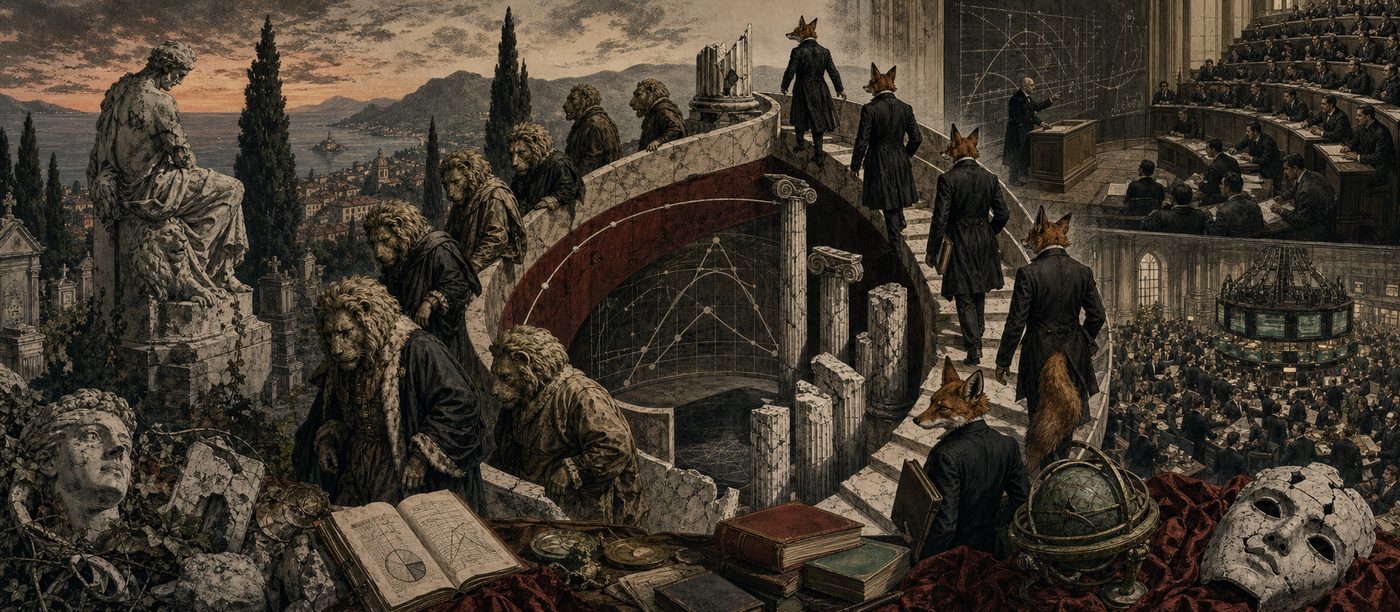
Continued centrality under contest42–62%
Reframed and qualified16–30%
Marginalization / canonical eclipse5–24%
New-paradigm renaissance7–14%
4 outcomes · from the researchFull forecast →
Openthrough ~2035

A Graveyard of Aristocracies

Vilfredo Pareto — elite theory and the circulation of elites, through and beyond Burnham
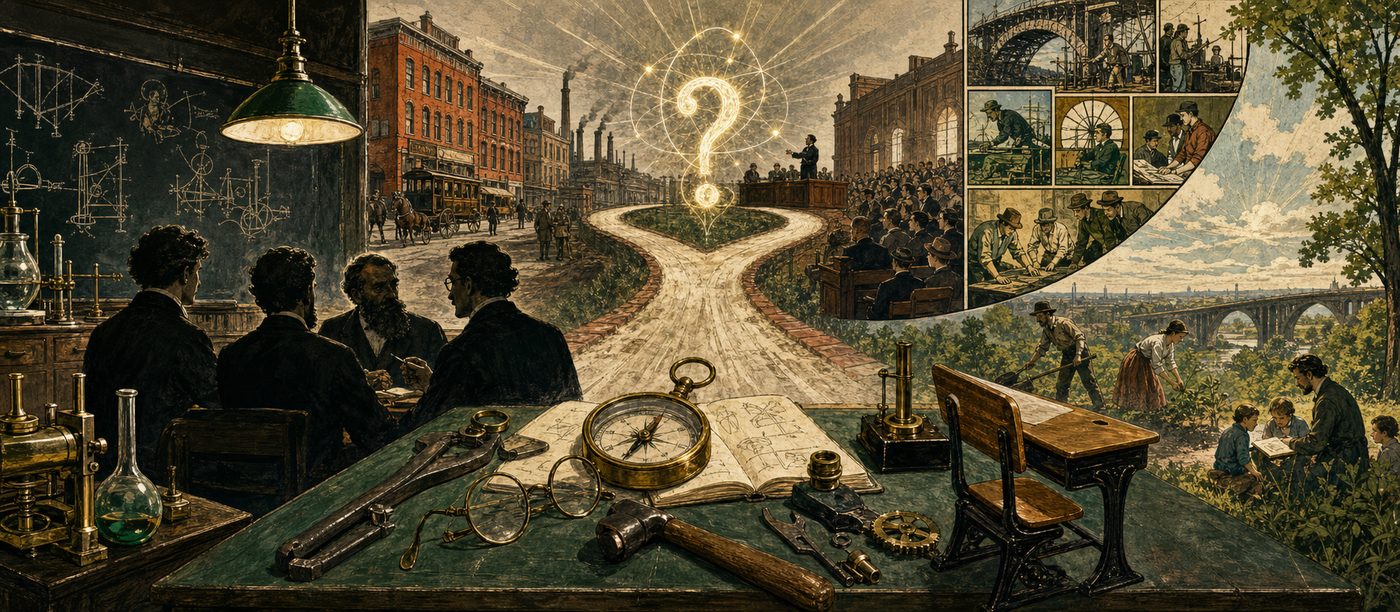
Mainstream normalization50%
Politicized boom and partial bust27%
Cliodynamic breakthrough12%
Quiet fade / reabsorption11%
4 outcomes · from the researchFull forecast →
Opena generation, framed through ~2045 (trajectory of influence and interpretation)

The Cash-Value of Truth

American pragmatism — Peirce, James, Dewey, and the tradition's eclipse, revival, and reach

Stable Minor Tradition — Label Survives, Tent Does Not Widen32–42%
Peircean Consolidation as Recognized Second-Tier School26–36%
Applied Capture Without Philosophical Deepening14–22%
Institutional Contraction and Fragmentation8–16%
4 outcomes · from the researchFull forecast →

The Modern World 2

Openthrough 2030, with structural notes to 2035

The Map of American Power

The US geopolitical position in 2026: grand strategy, alliances, and trajectory

D1 Dollar: Gradual Erosion (Modal)55–65%
I1 Iran: Weakened-Persistent (Modal)50–60%
E1 Decoupling: Managed Bifurcation (Modal)50–60%
L2 Hemisphere: Muddle (Modal)45–55%
A1 Alliances: Indo-Pacific Deepens, NATO Strains But Holds (Modal)45–55%
+30 more outcomes in the corpus
35 outcomes · from the researchFull forecast →
Openthrough 2035

The Argument Over Money

The U.S. economy and financial system — from Hamilton's debt and the 1862 greenback to the Fed, a $39T debt, the AI-vs-entitlement race, and the dollar's future through 2035

The Grind (Productive Muddle-Through)33–45%
Financial Accident / Recession With Teeth17–28%
Inflation Re-Embeds (Fiscal Dominance, Lite)17–27%
AI-Led Escape10–20%
4 outcomes · from the researchFull forecast →

Heritage 1

Opennext ~10-20 years / one generation

The Emigrant's Atlas

An Irish and Czech-Galician-Baltic American ancestry

Symbolic continuity, Irish-dominant45–60%
DNA-driven documentary revival25–40%
Instrumental heritage / EU citizenship15–30%
Roots tourism / experiential reconnection10–20%
4 outcomes · from the researchFull forecast →

Ad Tech & Media

The trade desk's predictions — also on the Ad Tech board18 markets

Antitrust & Regulation 2

Live marketMedia & Advertisinglogged Friday, July 3, 2026

Will the remedies ruling in US v. Google (ad-tech antitrust) order a structural divestiture of Google's ad-tech assets (AdX and/or DFP), rather than behavioral-only remedies?

⚖️
Forced AdX sale (YES)
33–42%

Four priced outcomes for Judge Brinkema's ad-tech remedy: a forced AdX-only divestiture is the narrow favorite at 33–42% (YES), essentially tied with a hard conduct-only order at 34–42% (NO) — the seven profiles split 4 YES / 3 NO, Elias Lantern alone on a full AdX+DFP breakup.

👥 7 predictor profilesgrades Sunday, January 31, 2027📋 on the ledger
✓ GradedThursday, July 16, 2026

Will the January-2026 US TikTok joint venture stand and be treated as a qualified divestiture under the divest-or-ban law, rather than being ruled not-qualified or judicially unwound back to ByteDance control?

The January-2026 US TikTok joint venture most likely stands as a qualified divestiture at 66–76%, with a 'survives under legal cloud' runner-up at 13–19%; the desk splits 5 YES / 2 NO, Elias Lantern holding out for a judicial unwind.

✅ Qualified divestiture stands (YES) won🤝 called Qualified divestiture stands (YES) 66–76%
✓ the desk called it · Brier 0.084The grade →

Streaming & Platforms 1

Live marketMedia & Advertisinglogged Friday, July 3, 2026

Will Netflix, by its Q4 2026 report (~Jan 2027), disclose its ad-supported tier crossing a stated scale/ad-revenue milestone or confirm completion of its in-house Ads Suite cutover — rather than no in-window milestone being cleared under a strict read?

📊
Milestone disclosed (YES)
60–70%

Netflix most likely discloses an ad-tier milestone by its Q4 2026 report at 60–70% (YES), with a strict-reading 'doesn't cleanly count' NO at 17–25%; the desk splits 5–2, the risk being definitional, not business.

👥 7 predictor profilesgrades Sunday, January 31, 2027📋 on the ledger

Platforms & Deals 3

Openthrough 2028

Buying the Living Room

Fox's $22B acquisition of Roku and the fight for the connected-TV stack

Clears and grinds (base case)50%
Regulatory drag / forced remedies (partial bust)25%
Clean clears, flywheel ignites (bull)17%
Deal breaks or value destroyed (bear)8%
4 outcomes · from the researchFull forecast →
Openthrough 2029

On Leased Land

MiQ, the independent programmatic trading desk, and its CTV/ATV bet

Strategic Sale / Absorption — Bridgepoint exits MiQ to a strategic, ending independence35–43%
Persisting Independent — Recap, Secondary Buyout, or Continuation; Aggregator Survives, Margins Bleed24–32%
Erosion / Distress — Agentic Commoditization + Supplier Seam Break → Margin Collapse or Distressed Sale15–22%
Software Re-Rating — Sigma Becomes a Real Margin Story (bull)10–16%
4 outcomes · from the researchFull forecast →
Openthrough 2029

The Missing Front Door

Walmart's $1.4B acquisition of Vibe.co — completing a retail-media + connected-TV ad stack, and the long catch-up to Amazon

Absorbed Front Door, Gap Narrows on Rate Not Level (modal)38–46%
Catch-Up Stalls: Moat Unaccredited, Channel Conflict and SMB Churn Bite24–32%
Standalone Onramp Persists12–18%
Breakout: The Closed Loop Actually Converts10–16%
Deal Slips, Stalls, or Breaks (regulatory / diligence / walk)8–14%
5 outcomes · from the researchFull forecast →

Programmatic Infrastructure 4

Openthrough 2028 (directional to 2030)

Who Keeps the Spread

Programmatic CTV's DSPs and SSPs — and where the margin really sits for a platform-agnostic intermediary

Curation eats the stack (sell-side ascendancy)35–45%
The pincer (margin compression from both sides)30–40%
Walled-garden gravity (bifurcation, narrowed)15–25%
Agentic routing commoditized10–20%
4 outcomes · from the researchFull forecast →
Openthrough 2029

The Protocol War

How AI agents are being wired into the ad buy — MCP, AdCP, the IAB's ARTF, and what agentic buying does to CTV
Layered Coexistence on an MCP Substrate (negotiation + transport stack, governance split)36–44%
Garden + Model-Layer Enclosure (the open stack governs a shrinking remainder)26–34%
Agentic Plateau — pilots don't scale; the standards war stays pre-volume14–20%
Material Disintermediation — agents compress the open-market CTV stack by 202910–16%
Regulatory / Substrate Shock (wildcard — antitrust rupture OR MCP fragmentation)8–14%
5 outcomes · from the researchFull forecast →
Openthrough 2030

Closer to the Metal

Containerized bidding — when the buyer's bidder moves inside the exchange's data center, and who captures the margin it relocates

Absorbed / Bounded Plumbing (MODAL) — containerized bidding becomes real, multi-fabric open-web infrastructure but a commoditized SSP feature, not a new margin-capturing seat; at-scale workload is…40–46%
Margin Relocation with a Real Seat — in-fabric execution forms a DEFENDED independent-SSP hosting/curation rent and/or an incumbent-scale DSP becomes a tenant; the standalone DSP-infrastructure tier…20–28%
AdCP Topology Bypass — direct buyer-agent/seller-agent negotiation routes around the impression auction, shrinking the problem containerized bidding solves; relocated margin flows to publishers and…11–17%
Stall / Abandonment — the category stays pilot-bound and never escapes beta, or collapses into one dominant proprietary fabric; not even absorbed as a standard feature8–14%
Incumbent-Fabric Capture — containerization scales but a hyperscaler/walled garden (Amazon via AWS RTB Fabric + DTE, or Google), not an independent SSP, keeps the relocated spread; open-web…8–13%
5 outcomes · from the researchFull forecast →
Openthrough 2029

The Seller's Agent

The supply-side platforms that carry programmatic CTV — and their bet on attention, outcomes and AI

Squeezed but Standing38–46%
Absorbed into the Platforms18–26%
Up the Stack15–23%
Structural Break12–20%
4 outcomes · from the researchFull forecast →

Identity & Addressing 2

Openthrough 2030

The Address Knows You

IPv4/IPv6 and the global CTV programmatic landscape

Managed Degradation (Dual-Stack Equilibrium — IP Demoted, Not Dethroned)48–58%
Accelerated Displacement (Authenticated Takeover of Premium CTV)20–30%
Obfuscation / Regulatory Shock8–15%
IP Renaissance (Verified Linkages & IPv6 Prefix Standardization)7–15%
Residual Tail (Unmodeled Discontinuities)3–5%
5 outcomes · from the researchFull forecast →
Openthrough 2029

The Signal Layer

Identity in programmatic CTV — hashed emails, MAIDs, IP, ACR, clean rooms, and what survives to 2029

Messy Continuity — durable plural multi-signal, multi-graph stack38–48%
Walled-Garden Tilt — gardens gain decisively (gradual grind, not a fast tip)28–38%
Regulatory / Litigation Reset — a privacy step-change reshapes the stack10–16%
Open-ID / Standards Consolidation — a universal ID and currency converge toward parity8–15%
Residual tail — exogenous shock, signal cliff, or non-modeled break4–9%
5 outcomes · from the researchFull forecast →

Trust, Politics & Society 3

Openthrough 2030

Safe Beside What?

Brand safety in programmatic Connected TV — and the global fight over who sets the floor

Fragmented Floor (base case)35–45%
Content-Level Resolution18–25%
Walled-Garden Consolidation12–18%
Fraud-and-Fragmentation Drift12–18%
Re-coordination Under Legal Cover8–14%
5 outcomes · from the researchFull forecast →
Openthrough the 2028 presidential cycle (early 2029)

The Measured Screen

Political advertising migrates to connected TV — the smart-TV ACR and voter-file targeting stack, who captures the spend, the streaming regulatory gap, and whether any of it actually moves votes.

On-Curve Continuation — CTV climbs the flattening shoulder of its S-curve; the federal streaming gap stays open34–44%
Constrained Plateau — political dollars keep rising but CTV's SHARE stalls in the low-to-mid 20s%18–26%
Inventory Unlock / Re-Acceleration — a continuity-breaking unlock pushes CTV share materially higher (low-30s%)13–19%
Regulatory / Platform Break — a regulatory, judicial, or structural shock bends the trajectory (incl. structural wildcard)13–19%
Effectiveness / Credibility Deflation — the persuasion case breaks and share growth stalls below continuation7–12%
5 outcomes · from the researchFull forecast →
Openthrough 2029

The Living-Room Handoff

How social platforms — LinkedIn, Pinterest, Reddit, TikTok, Meta — extend their audiences onto Connected TV, and which ones credibly make the jump through 2029

Bifurcation / Split Verdict — LinkedIn durable, the other four a workaround being disintermediated36–46%
Near-Total Disintermediation / Full Inversion — even LinkedIn compresses to a thin licensing fee22–32%
Durable Multi-Platform Category — extension sticks for 2–3 players (LinkedIn + owned-rail Pinterest, ± a Meta pipe)16–24%
Meta Front-Runs — a shipped Meta CTV product (owned Reels-TV land-grab and/or demand network) reshapes the category12–18%
Regulatory Rupture — VPPA/state-privacy/DMA breaks the household-IP plumbing itself9–15%
5 outcomes · from the researchFull forecast →

Global Markets 2

Openthrough 2030

A Billion Screens

India's advertising market — the digital tipping point, programmatic CTV, and YouTube

Steady digital-led grind (base case)48–60%
The Bharat unlock (upside)15–25%
Trust-and-concentration drag (downside)10–18%
Structural shock (tail)7–13%
4 outcomes · from the researchFull forecast →
Openthrough 2030

Reach Ahead of Revenue

Latin America's programmatic Connected-TV market — Brazil, Mexico, and the gap between attention and money
Reach compounds into revenue (base case)50–60%
Reach without revenue persists (bear case)20–30%
The living room monetizes fast (bull case)15–25%
3 outcomes · from the researchFull forecast →

Media Theory 1

Openthrough ~2040 (roughly one academic generation)

The Medium Is the Message

Marshall McLuhan — print, the global village, and the forms that remake us

Bifurcated Consolidation40–50%
A Third Fading Moment20–30%
Which-McLuhan Realignment12–20%
Methodological Rehabilitation10–18%
4 outcomes · from the researchFull forecast →