OpenFaith & Religionthrough ~2040 (trajectory of scholarly interpretation)
45–55%
Most likely outcome
Provincialization (most likely)
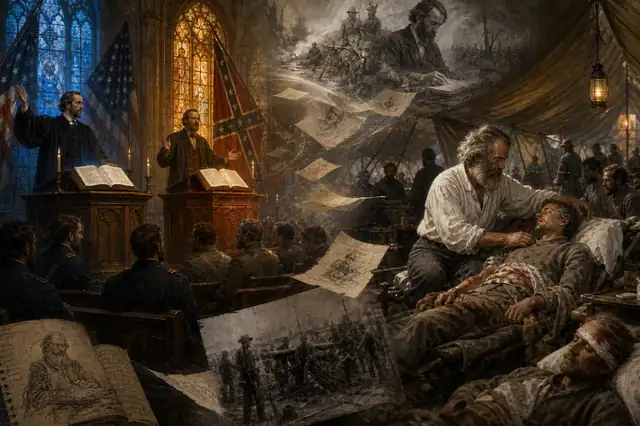
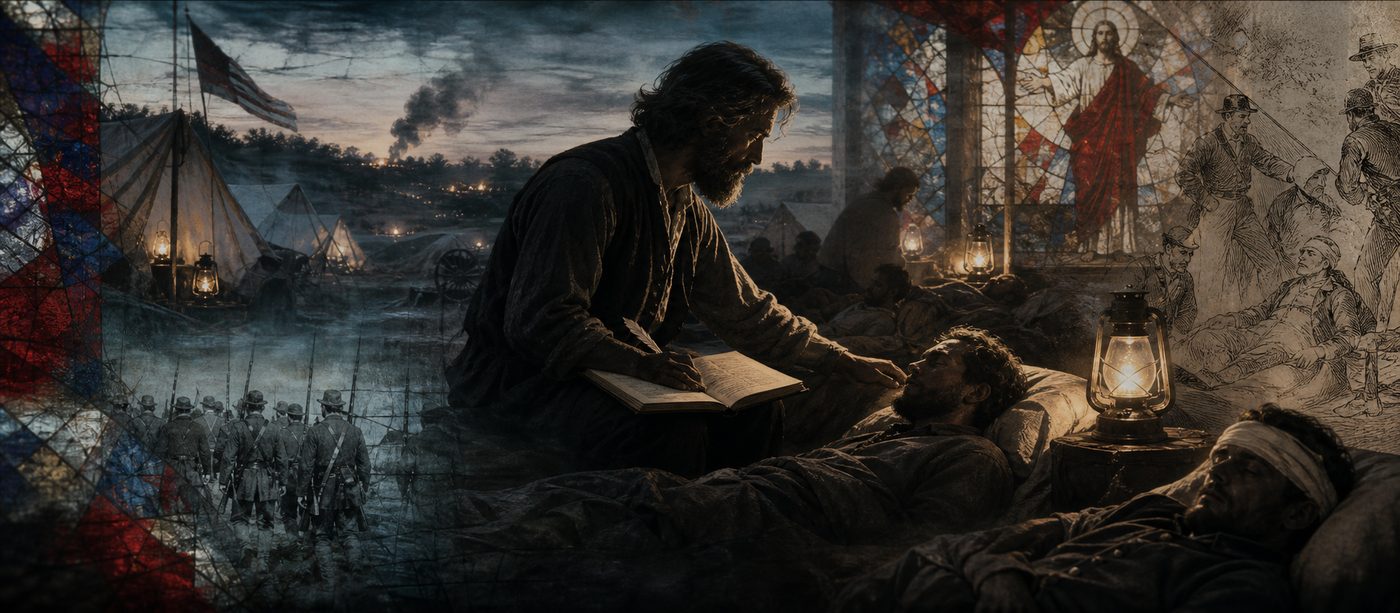
The Civil War's religious drivers — and Walt Whitman
Read the full research →01The Outcomes — 4 scenarios, priced by the research
Provincialization (most likely)45–55%
Canonical white-Protestant frameworks (Noll, Stout, Faust, Wilson) survive but are demoted from 'the' account to the account of white-Protestant meaning-making, reset inside a larger plural story centered on the enslaved's religion and the Black church.
Drivers
- enslaved-religion recentering
- maturation/fragmentation of the religious turn
- demographic change in the professoriate
Signals to watch
- a major synthesis subordinating 'theological crisis' to a plural frame
- prize-winning monographs centered on Black or transnational religion
- syllabi reorganized around emancipation-as-religious-event
Horizon · early-to-mid 2030s
Transnational/Atlantic reframing dominates20–30%
The American case is routinely read inside Atlantic emancipation (Britain, Haiti, Brazil, Cuba) and global 19th-century religion-and-nationalism, retiring 'American exceptionalism' in providential thought.
Drivers
- comparative frame
- global-history momentum
- decentering of Anglo-Protestant narratives
Signals to watch
- special issues pairing U.S. emancipation with Caribbean/Latin American cases
- Haiti/Vodou moving from outlier to standard comparison
Horizon · mid-2030s
Public-memory capture / culture-war repolarization15–25%
Monument, Lost Cause, and religious-nationalism politics pull the scholarship toward present-centered framing; Wilson and Blight become the most-cited work for their public relevance.
Drivers
- salience of memory politics
- study of 'Christian nationalism' seeking genealogy
- public funding following controversy
Signals to watch
- citation spikes on the Lost Cause and religious nationalism
- historians recruited into present-day commentary
- Whitman re-enlisted as a usable 'democratic faith'
Horizon · already underway; intensifies through the late 2020s
Stagnation / contraction5–15%
Humanities cuts and department shrinkage starve the field; major questions go quiet for lack of scholars and positions; frameworks ossify into textbook orthodoxy.
Drivers
- structural decline of the academic humanities
- collapse of the tenure pipeline
Signals to watch
- falling dissertation counts in 19th-century American religion
- graduate-program closures
- thinning journals
Horizon · slow trend across the horizon
Probabilities are the research's own scenario bands, priced as outcomes. The full argument — history, current state, drivers, and sources — lives in the corpus: read the Future Trajectory chapter.