OpenThe Modern Worldthrough 2035
33–45%
Most likely outcome
The Grind (Productive Muddle-Through)
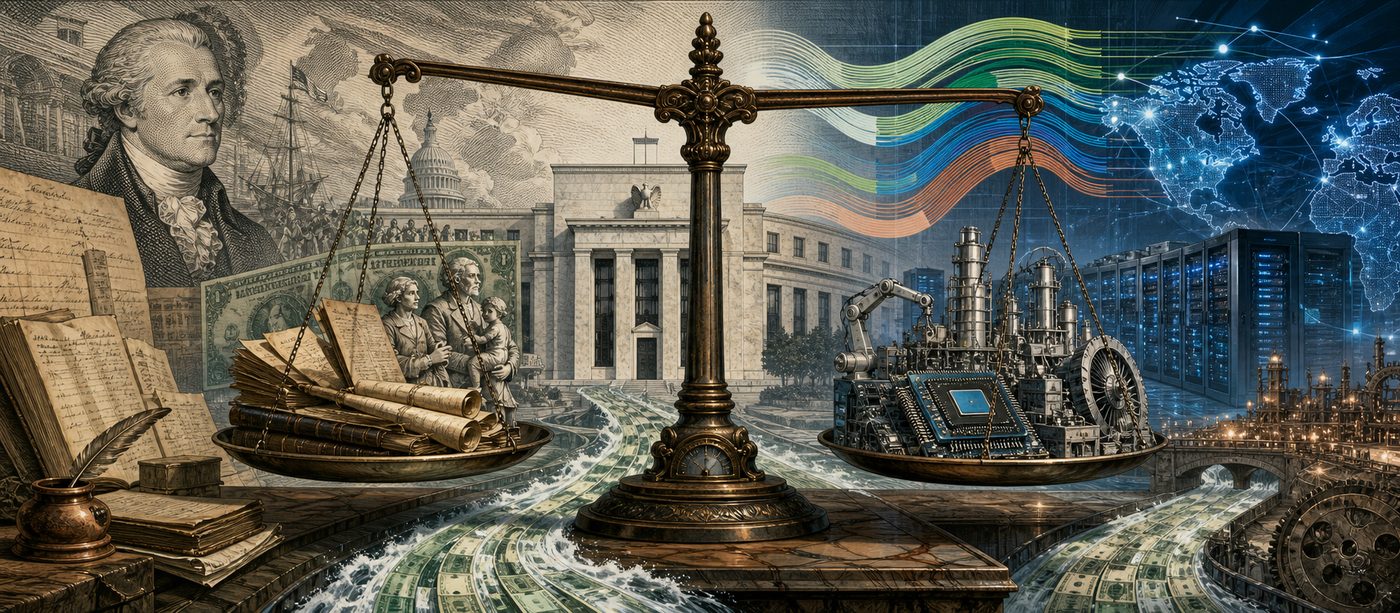
The U.S. economy and financial system — from Hamilton's debt and the 1862 greenback to the Fed, a $39T debt, the AI-vs-entitlement race, and the dollar's future through 2035
Read the full research →01The Outcomes — 4 scenarios, priced by the research
The Grind (Productive Muddle-Through)33–45%
The 2026 energy spike fades; core inflation stays sticky ~2.5-3%; the Fed keeps just enough independence; growth runs ~2%. The debt climbs toward ~118-122% of GDP without rupturing; recurring debt-ceiling scares (next binding ~mid-to-late 2027) resolve before each X-date; the dollar slips to the low-50s% of reserves while gold rises as the store-of-value rival; at least one ordinary recession is cleared in the U.S.'s sharp-but-short way.
How this number was derived
Three converging processes: (1) base rate — the dominant historical experience of a large-debt reserve sovereign is to grow/inflate the ratio sideways (Japan >200% for a decade, no crisis); (2) market — prediction markets price only ~22-28% recession-2026 and a modal Fed 'hold'; (3) decomposition — P(no decade-defining crisis) x P(AI helps but does not escape) x P(Fed keeps enough credibility) lands high-30s-to-low-40s. Plurality, not majority — system stress keeps it below 50%.
Drivers
- all eight drivers at default weights
- demographics and interest grinding up
- AI helping modestly
- the dollar buying time
Signals to watch
- core PCE drifting toward 2.5%
- ordinary auction tails and bid-to-cover
- the term premium rising gradually not in spikes
- foreign official demand soft but not striking
Horizon · The default texture of the whole 2026-2035 window.
Financial Accident / Recession With Teeth17–28%
A discrete shock breaks the grind — most likely an AI-capex/concentration unwind (the ~$400B annual depreciation outrunning revenue, the most-weighted names falling 30-50%) transmitting through household wealth into consumption and GDP; or a private-credit default cycle testing the marks and gates for the first time and looping back into the G-SIBs; or a debt-ceiling X-date / term-premium spike firing the basis trade. The Fed catches it, but the catch is larger and more explicit than the last.
How this number was derived
Anchored on the market near-term recession read (~22-28% for 2026), extended across the decade and conditioned up for severity by the corpus's untested fragilities: a $1.5-2T private-credit sector 'not tested in a severe downturn' (FSB), record equity concentration (Mag-7 ~34%) transmitting an AI-capex reversal through a K-shaped consumer where the top decile drives ~half of spending, and the Treasury basis trade / a debt-ceiling X-date as candidate 'LDI-equivalent' amplifiers. P(recession) x P(a fragility fires | recession) lands low-20s%.
Drivers
- AI concentration reversing (Channel A)
- non-bank credit amplifying and obscuring
- the K-shape transmitting
- the debt-ceiling/basis-trade tail as ignition
Signals to watch
- hyperscaler capex-to-FCF turning negative or debt-funded
- private-credit NAV markdowns and binding redemption gates
- repo-rate spikes and basis-trade deleveraging
- a debt-ceiling X-date approaching amid risk-off
Horizon · Possible any year; the tail is fattest where a 2027+ debt-ceiling episode coincides with an AI-concentration wobble.
Inflation Re-Embeds (Fiscal Dominance, Lite)17–27%
Energy, tariff pass-through, and a Fed that eases too early settle inflation structurally at 3-4%. The Fed's anti-inflation credibility erodes; the term premium rises, partly offsetting the interest-bill relief the cuts were meant to deliver. Real wages at the bottom lose ground; the K-shape widens. The saver, through negative real returns, quietly pays down the debt — the WWII-style financial repression without a war to justify it.
How this number was derived
Decomposition of the Fed-independence tail: P(a Trump-nominated Fed cuts under pressure into elevated inflation in 2026-2028) is materially above zero given the administration's stated demand and the Warsh thesis; P(expectations unanchor | premature cuts with tariffs/energy already in the price level) is the conditional, anchored on the 1970s Burns base rate. The product, over a multi-year window and net of the ~57% 'zero cuts 2026' market read (which pushes timing to 2027+), yields low-20s%.
Drivers
- Fed independence eroding under fiscal dominance
- tariffs and energy as inflation seeds
- demographics/interest making inflation fiscally attractive
Signals to watch
- a rate cut into 4%+ headline CPI
- 5y5y breakevens climbing above ~2.5%
- the term premium and 30-yr yield rising with cuts
- the dollar weakening on the policy mix
Horizon · The fork is most likely 2026-2028; the embedded-inflation regime, if set, defines the back half of the decade.
AI-Led Escape10–20%
AI's supply-side channel finally shows up in the aggregate data; TFP lifts potential output, nominal growth runs 4.5-5%+, and the r<g math reasserts. The debt ratio stabilizes, equity leadership broadens beyond the Magnificent Seven, real wages rise, and the entitlement gap looks fundable from a larger tax base.
How this number was derived
Upper tail of the AI-productivity distribution. Central estimates run from Penn Wharton (~0.2pp/yr TFP-growth peak ~2032) to Acemoglu (~0.06pp/yr). An escape requires realized productivity at or above the Goldman/McKinsey bull cases — not visible in 2026 aggregate data — so it is weighted as the top ~15-20% of a distribution centered on 'modest and not-yet-visible.'
Drivers
- AI/productivity Channel B succeeds
- structural Treasury demand holds financing cheap
- tight labor + productivity lifts the taxable base
Signals to watch
- multifactor productivity turning up durably
- AI revenue distributing beyond the hyperscaler-to-Nvidia loop
- capex-to-FCF staying below one without debt funding
- the equity rally broadening
Horizon · Distinguishing features visible 2028-2032; fiscal relief compounding into the early 2030s.
Probabilities are the research's own scenario bands, priced as outcomes. The full argument — history, current state, drivers, and sources — lives in the corpus: read the Future Trajectory chapter.